
The Pig
If you’re anything like me, you’re the kind of person who walks into a store, reads labels, asks questions, and wants to know exactly what you are feeding your family. We refuse to settle for “good enough” when it comes to our health and the health of our loved ones.
There is a lot of controversy around eating pork. In some cultures it is considered an unclean meat. So let’s break this down.
The pig has a monogastric stomach, which means, like ours, the pig consumes its food and that food goes straight into its body tissues. Unlike cows or sheep, who are ruminants, pigs don’t have that multi-compartment “filtering” system. More directly, what they eat becomes them.
The diet of the pig is also different. Pigs are omnivores. They eat grasses and forage like cows do, but they are also meat-eaters. They love eggs, milk, grains, vegetables, fruit, and yes, they love them some flesh. Sometimes they have been known to grab hold of a rogue chicken who wandered into their pens. Honestly, they truly are nature’s trash can.
So, if a pig becomes what it eats, then what exactly has the pig we’re buying been eating?
I wrestled with that question for a long time.
I knew I really didn’t want to give up eating a delicious crispy, salty piece of bacon, or never again taste the tenderness of a tangy bbq pork sandwich, so I put parameters in place for the pork my family and I would eat.
I knew hands down, 10000% that I did not ever want to buy pork raised in a conventional setting ever again. Not only from a hygienic standpoint, as the idea of pigs wallowing in their own filth grosses me out, but also from an ethical standpoint.
Pigs are smart and emotional and expressive. Whenever I confine my hogs for any reason, they panic. They hate feeling trapped.
In many conventional systems, piglets have their teeth clipped and tails docked because overcrowding and stress lead to biting. Sows can spend weeks in farrowing crates where they can’t turn around. It reduces crushing piglets, yes, but it always left me asking, is this the only way?
And as a mom, I realized something: I couldn’t control everything in the food system. But I could control what I brought into my house.
I wanted full confidence that when we prayed over our food “Lord, let this food nourish and strengthen our bodies…” that I was doing everything in my power to provide quality food. There is nothing worse than the kids asking “Mom, is this food good for our bodies?” and then answering sheepishly “ahhhh, yeah kinda, maybe.”.
So I decided to raise pork differently.
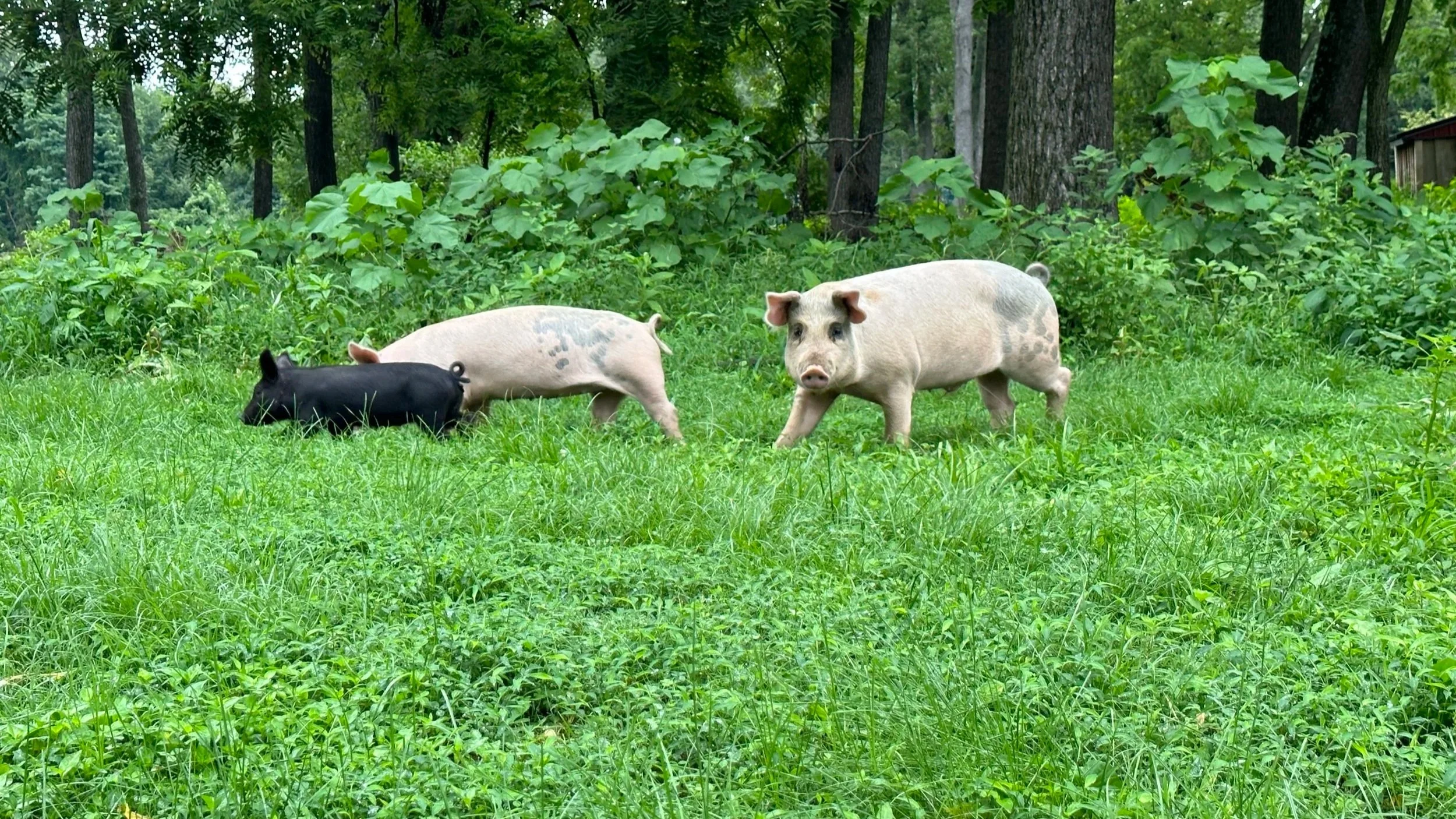
Our hogs are raised on tested, chemical-free, non-GMO, soy and corn-free grains. They live on pasture and in the woods. They root and run around and they act like pigs.
I get SO much joy walking out to their paddocks and calling them up. In typical stampede fashion, you hear them tearing through the branches and leaves before you see them. Their ears are flapping all around and they are grunting in a wild excitement sorta way. Hahahaha! I absolutely love it!
I set out to solve a problem in my own kitchen.
My number one priority to growing a clean pork is their diet. If they are what they eat then I will make sure what they eat is as good and clean as it can be.
Along with their clean grain rations, they have 24/7 access to the pastures and woods. Sometimes, like in the winter months when we need to keep them close by, their pastures are smaller, and other times they have acres deep into the woods.
They also love all the kitchen scraps and extra milk and whey I feed them.
Their ability to clear out woods is incredible. By turning pigs out in the dense wooded areas it stimulates growth that otherwise would have laid dormant. In just a few short months grass grows in places it hadn’t before and then that allows us to graze other livestock out in those areas that would have just been unusable space.
The smells aren’t nearly as bad when raised outside either. Sure, there will always be stink when animals are involved, but for the most part the biggest smell is when the pigs toss their feed around and it starts to ferment. It’s not the poo so much.
I have 3 breeding pigs: our boar, ‘Moto Moto’, and his ladies, the sows: ‘Gloria’ and ‘Big Momma’. Moto Moto is a purebred Mulefoot, Gloria is a Berkshire, and Big Momma is a BerkshireX.
*An intact male is called a boar and a grown female is called a sow.
All three of my breeding hogs are wonderful around us and are great parents as well. Genetics play a huge role in whether or not the sows will crush their piglets.
Unfortunately, conventional breeds have mostly bred out the pigness in the pig and they are breeding for fast growth and pink skin. The end goal is to make the companies more profitable.
Now, you can only imagine that hogs raised in a confined/conventional system have a very different flavor profile than hogs raised out on pasture and woods. The breeds of the hogs that thrive in the environments of pastures and woods have a much deeper flavor and meat color. You can SO taste the difference. It’s juicy and full of flavor.
I went to visit our processor last week to check out my hog carcasses and I asked them if they noticed any differences between my pork and the other pork from known farmers who raised their hogs conventionally. They noted the sizes looked much the same but mine had less overall fat, even though my hogs are a known lard pig breed, and they noted the obvious color difference. My pork was deeper pink in color vs the standard pale pink.
There are studies that show the nutritional density of pastured pork is greater, due to the increased forages they are eating. So exciting!
Those of us who are trying to build strong kids, support our hormones, recover from pregnancies, or simply feed our families well, this matters to us.
Here’s what I’ve come to believe:
There are two very different porks in this world. One is raised for efficiency and the other is raised with intention.
As parents, we feel the weight of that difference. We are the ones cooking the meals. We are the ones reading the labels. We are the ones who carry the quiet burden of wondering if we’re doing enough.
You don’t have to raise your own pigs, but you can choose intentionally.
When you choose clean, pastured pork, you are not just making dinner, you are stepping into your role as protector and provider. You are deciding that “good enough” isn’t good enough for your family.
If you can’t access quality pork, it may truly be better to skip it altogether.
However, if you’ve been looking for pork you can feel confident about, pork raised by a mom who asked the same hard questions you’re asking, then I’d be honored to feed your family alongside mine.
If you’ve read this far, I have a feeling you’re my kind of people.
And if you’re going to test the pork waters, don’t commit to a whole freezer full just yet. Start with the sampler.
It’s got the bacon, It’s got the sausage, It’s got the chops.
Basically, it’s everything you need to decide whether you’re going back to grocery store pork… or not.
And if your family suddenly goes quiet at the dinner table because everyone’s chewing too happily to talk…you’re welcome!
So, consider this your official invitation to upgrade your pork.
Try the pork sampler HERE!
